兰陵王
Is the rapid growth of China’s emerging industries driven by industrial subsidies?: People’s Daily_我的网站

A | (ECNS)-- China's newly implemented Ethnic Unity and Progress Promotion Law has elicited a predictable response from certain Western media outlets. Whenever ethnic unity is referenced, some Western critics rush to frame it as "assimilation" or a push for uniform national identity. Fan Yichou, associate professor at the Law School of Minzu University of China, argues that such misinterpretations arise primarily from projecting Western historical nation-state building trajectories onto China's ethnic policies. Put simply, some Western observers do not view China from the perspective of its domestic social realities, but rather judge it through the lens of their own historical experience. Fan argued that the traditional Western nation-state model rests on a core premise: one ethnic community ought to align with one sovereign state, with political boundaries largely overlapping ethnic territories. To build culturally homogeneous nation-states, most Western powers historically sought to eradicate internal ethnic diversity through assimilation, exclusion, and other coercive measures. Such nation-building drives were often accompanied by territorial conquest, mass population displacement, and systemic violence. He drew on arguments laid out by Canadian political philosopher Will Kymlicka, who observes that the classical European template of nation-building rested on an implicit consensus: states should strive to become culturally homogeneous, by either assimilating national minorities or expelling them. For centuries, this ideal of a mono-national state shaped state policy across almost all Western European countries, with Switzerland stands out as the only major exception. This deep-rooted historical trajectory continues to frame contemporary discourse on ethnic governance. A stark modern illustration emerged in 2025, when Danish local authorities took away the newly-born daughter of an 18-year-old Inuit mother from Greenland just one hour after birth following a controversial parenting competency assessment. Her case was far from isolated. According to reports by the BBC and other media outlets, another Greenlandic mother had all three of her children under state custody. She was first subjected to a so-called parenting competency test after social services raised concerns about the language development of her eldest daughter. Although the Danish government has decided to stop using such tests on Greenlandic families, local authorities have yet to halt the practice. The enduring harm of assimilationist policies extends far beyond this Danish case. UNESCO’s Memory of the World archives document that Canada's Indigenous residential school system continuously operated for nearly 150 years, with the explicit state objective of assimilating Indigenous children into settler society. Generations of Indigenous children were forcibly separated from their families, severed from their ancestral languages, cultural traditions, and intergenerational knowledge systems. The United States has grappled with comparable challenges. According to a 2025 Associated Press report, Native American children in California are roughly about four times more likely to enter the foster-care system than their peers. Newborns separated from their mother shortly after birth. Generations of children torn apart from their families and ancestral languages. Indigenous youth who remain vastly overrepresented in foster-care placements to this day. All these are legacies of the West's long-standing obsession with assimilation. That explains why, when some in the West hear China speak of "ethnic unity," they instinctively equate it with "assimilation." In reality, they are projecting their own social trauma onto China. China's context, however, is fundamentally different. As Fan Yichou notes, China has long been a unified multi-ethnic country. Within the Chinese tradition, political unity has not demanded cultural uniformity. Instead, unity and diversity have coexisted across most of the nation's history. This outlook finds theoretical expression in the concept of plurality-in-unity put forward by renowned Chinese sociologist Fei Xiaotong. In his framework, China's 56 ethnic groups represent the plurality, whereas the Chinese nation embodies unity. From this perspective, the Ethnic Unity and Progress Promotion Law is not designed to eliminate ethnic differences. Instead, it seeks to strengthen a shared sense of belonging while respecting cultural diversity. This distinction highlights a broader divergence between China and the West in approaching identity and social cohesion. In many Western societies, historical assimilation sought to diminish group differences and compel minority groups to conform to dominant-culture norms. By contrast, China's emphasis on forging a strong sense of community for the Chinese nation is not intended to obliterate diversity. It seeks to build shared civic and national identity, while enabling all ethnic groups to sustain their own languages, customs, and cultural traditions. Ethnic groups may speak different languages, practice different customs, and vary in development level. Yet they can still uphold shared dedication to national progress and a common sense of belonging within a unified multi-ethnic state. Genuine ethnic unity does not require everyone to fit into the same mold. It means ensuring that different ethnic groups can participate in national development while maintaining their own cultural characteristics and thriving with equal dignity and equitable opportunities. So when some in the West equate China's "ethnic unity" with "assimilation," their judgment stems not from an accurate assessment of China’s reality, but from a subconscious projection of their own historical burdens, contemporary social anxieties, and deep-rooted institutional scars onto China's ethnic policies. They are either unwilling or unable to fully comprehend China's governance philosophy and practices, yet arbitrarily pass arrogant judgment on the country. The outcome of this biased approach will be no exception of absurd narratives that fundamentally contradict objective reality. 
 。
。
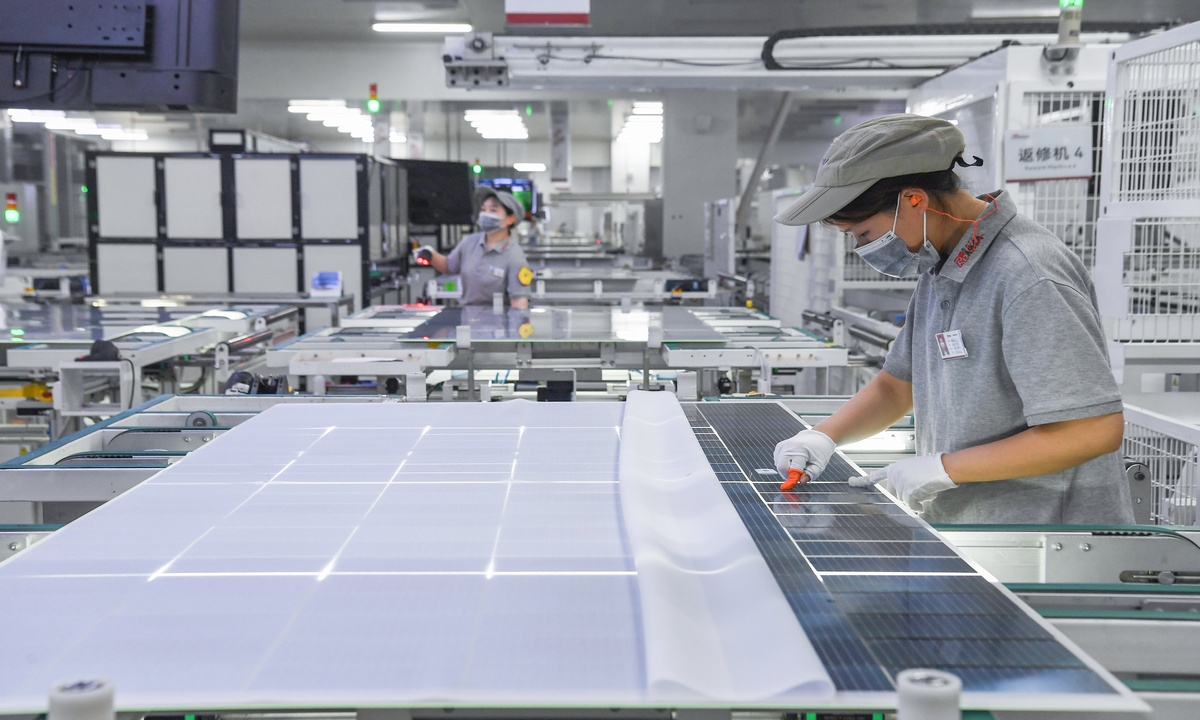
Workers assemble solar photovoltaic modules at a smart manufacturing workshop of Ronma Solar Energy Group in Jindong district of Jinhua city, East China's Zhejiang Province, on July 28, 2026. Photo: VCG
China saw robust exports in electric vehicles (EV), lithium batteries and photovoltaic products, known as the "new three," in the first half of this year. More notably, robotics, artificial intelligence (AI) and innovative drugs, which represent the future direction of industrial development, are also emerging as new calling cards for China's foreign trade.
However, the impressive performance provoked unease among some Western media outlets and politicians. Some have deliberately portrayed China's rapid industrial development and strong competitiveness as a result of government subsidies, pushing the false claim that subsidies have created overcapacity and those low-priced Chinese products are flooding global markets. Such fallacies, which simply equate industrial subsidies with overcapacity, are not only logically flawed but also factually groundless.
In practice, many countries adopt industrial policies tailored to their national conditions and development needs, such as providing research and development (R&D) subsidies for emerging industries and risk related subsidies for agriculture.
Well-designed industrial subsidies can help address market failures, promote technological innovation and environmental protection, reduce poverty and support balanced development, rather than cause so called "overcapacity."
Multiple reports by the United Nations Conference on Trade and Development have noted that the number of industrial policies worldwide has grown rapidly over the past five years, with R&D subsidies, tax incentives and low interest loans for emerging industries becoming common international practices.
Forcibly linking industrial subsidies to "overcapacity" is, in essence, a political manipulation based on double standards. The US, for example, plans to provide $750 billion in various subsidies from 2022 to 2031 under its Inflation Reduction Act. Subsidized EVs are subject to requirements such as production and sales in the US or North America, effectively excluding other WTO members. US industrial subsidies for AI are even greater than those of all other countries combined.
Similarly, according to incomplete statistics, the European Commission is expected to provide more than 1.44 trillion euros ($210 billion) in various subsidies between 2021 and 2030. The EU's Industrial Accelerator Act links local content directly to financial support through "Made in EU" requirements, creating serious investment barriers and institutional discrimination.
Have these massive subsidies been labeled as causing "overcapacity"? The answer is no. While claiming that China's industrial subsidies lead to so-called overcapacity, these countries are themselves providing massive subsidies to their own industries. Such double standards amount to selective accusations targeting China, aimed at politicizing trade and economic issues and weaponizing industrial policy.
At a deeper level, accusations that "China's industrial subsidies cause overcapacity" are merely a pretext, reflecting growing anxiety and fear over the rising competitiveness of Chinese industries.
Looking back at the repeated hype in Western media, the criticism has consistently targeted China's most globally competitive industries, including new-energy vehicles, photovoltaics and power batteries. This exposes the real intention of shifting the blame for their own lagging industrial development onto China while stepping up restrictions against Chinese industries.
China's breakthroughs in these industries have been driven by advances in homegrown technologies, complete industrial and supply chains, and robust market competition, rather than by policy subsidies as some have claimed.
In recent years, China has taken multiple steps to regulate and improve its subsidy policies, from reviewing and correcting inappropriate local subsidies to exploring a unified negative list mechanism for local fiscal subsidies. China applies subsidies equally to all market entities, including foreign invested enterprises, strictly follows WTO rules, and continues to improve the compliance, effectiveness and transparency of its subsidy policies.
Rather than fabricating and hyping baseless claims about subsidies and obsessing over building trade barriers, certain Western media outlets and politicians should focus on addressing their own weaknesses and increasing investment in research and development. They should embrace healthy market competition with an inclusive mindset, promote mutual benefit through greater openness, and win markets and drive progress through genuine innovation.
This was compiled and translated by the Global Times English edition based on an article published in the "Chisu Jinsheng" economic commentary column of the People's Daily on August 10, 2026.。

B |
Current article:http://sdx7hht.zhouangnaoguangsundianzhenmou.cfd/rfvi/20260826/1412419.html
Published on:06:52:55



 。
。